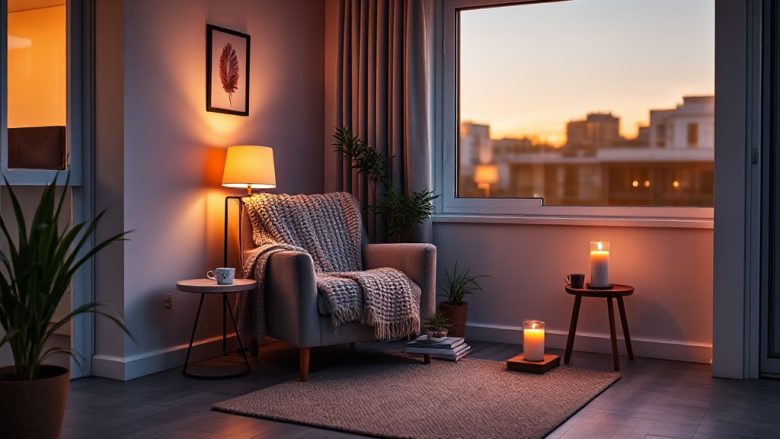
Cosiness doesn’t come from buying more things. It comes from warm light, soft texture and low contrast — three things you can start fixing in the next five minutes with whatever you already own. If you’ve just moved into a first flat and the place feels more like a waiting room than a home, that’s the whole diagnosis. Nothing is broken. The room is simply too bright, too hard and too evenly lit.
Start Here: The Five-Minute Version of How to Get Started With Cosy Home Styling
Before you spend a penny, do this. Walk into your main room, turn off the ceiling light, and switch on every small lamp you own. If you don’t own any lamps, drag a bedside lamp into the living room and plug it in. Then sit down for two minutes and look around.
That single change — killing the overhead light — does more for atmosphere than a new sofa. Overhead lighting flattens everything. It throws shadows downward, makes corners look grey and turns an ordinary evening into an office. Lamps at waist height or lower do the opposite: they light the walls, bounce warmth off surfaces and make the room feel smaller in a good way.
Next, look for the three hardest things in the room. Usually it’s a bare floor, a glass or metal coffee table, and a wall with nothing soft near it. You’re not going to replace any of them today. You’re just going to notice them. That’s your shopping list for the next few weeks, and it’s a cheap one.
That’s the five-minute version of how to get started with cosy home styling. The rest of this article is the slow version — three layers that make the difference between a room that’s tidy and a room you actually want to sit in.
Layer One: Light, and Why Low Beats Bright Every Time
Light is the layer people skip, because lamps feel like an afterthought next to furniture. In practice it’s the first thing to get right, and it’s the cheapest to fix.
Think in terms of three heights. You want at least one light source below eye level (a floor lamp or a lamp on a low side table), one at roughly table height (a desk lamp, a lamp on a shelf), and ideally one very low and very small — a nightlight, a candle, a tiny lamp on the floor beside a chair. Three points of light at different heights make a room feel layered. One big light makes it feel lit.
Bulb colour matters more than the fitting. Look for warm white, somewhere around 2700K. Cool white bulbs, the ones that read almost blue, will undo everything else you do. If your flat came with cool bulbs, swap them. It’s a couple of pounds per bulb and it changes the entire mood of a room in the evening.
Dimmers are the quiet hero here. A cheap plug-in dimmer on a single lamp lets you drop the brightness as the night goes on, which is exactly what your body expects. If you can’t dim, add more low-wattage lamps and use fewer of them at once. Two lamps at half brightness beat one lamp at full.
One more thing: point light at walls, not at the room. A lamp aimed at a pale wall creates a soft wash that makes the space feel bigger and warmer at the same time. A lamp aimed straight out into the middle of the room just creates glare.
Layer Two: Texture, or How to Soften a Room That Feels Like a Rental
Rented flats are hard by design. Laminate floors, painted walls, wipe-clean surfaces, blinds instead of curtains. Every one of those choices is practical and none of them is cosy. Texture is how you push back, and you can do it without touching the structure of the room.
Start at floor level. A rug is the single highest-impact purchase for a cold-feeling room. It doesn’t need to be big or expensive — it needs to be under your feet where you sit. A small rug beside the sofa, where your feet actually land, does more than a large one in the middle of the room. If you can only afford one, buy the one you’ll stand on.
Then go for softness at hand height. A throw blanket over the arm of a chair. A cushion or two that you actually lean on rather than arrange. Fabric that invites touch: wool, cotton, linen, chunky knits, anything with a bit of weight and a visible weave. Avoid anything shiny or synthetic-looking if you can. Shiny surfaces reflect light hard, and hard reflections are the opposite of cosy.
Curtains are worth a mention because they solve two problems at once. They soften the window, and they cover the cold rectangle of glass that makes a room feel exposed after dark. If you can’t fit a rail, a tension rod and a pair of ready-made curtains will do. Hang them wide enough that they overlap the wall on both sides, not just the window.
Finally, break up flat surfaces. A bare coffee table is a hard surface with nothing soft near it. A tray, a couple of books, a small plant, a candle — none of it costs much, and together they stop the eye from sliding straight across the room. The trick isn’t clutter. It’s two or three things that look like someone lives here.
If you’re working to a tight budget, spend in this order: rug, lamp, curtains, throw. That sequence gives you the biggest change per pound, and each one makes the next one look better.
Layer Three: Scent, Sound and the Small Signals That Say Home
Scent is the layer people forget, and it’s the one that hits before you’ve consciously noticed anything else. Walk into a room that smells of nothing and it feels like a hotel corridor. Walk into one that smells faintly of wood, citrus peel or clean linen and your shoulders drop.
You don’t need a diffuser collection. One candle, one reed diffuser or a simmer pot on the hob will do. Simmer pots are the cheapest option: a pan of water with a few slices of orange, a cinnamon stick and a spoon of vanilla essence, left on the lowest heat for an hour. It fills a flat for pennies and it smells like someone’s been cooking, which is its own kind of comfort.
Be careful with strength. Scent should be something you notice when you walk in and then stop noticing. If you can smell it from the hallway with the door closed, it’s too much, and it’ll start to feel like a shop rather than a home.
Sound matters more than most people admit. A room with nothing to absorb noise echoes, and echo reads as emptiness. Rugs, curtains, cushions and books all soak up sound, so the texture layer is doing double duty. If your flat still sounds hollow, a couple of soft furnishings near the walls will take the edge off. Low background sound — a record, the radio turned down, rain on a window — fills the silence that makes an empty flat feel emptier.
Then there’s the low-contrast rule, which ties all three layers together. Cosy rooms don’t have sharp edges of light and dark. They have soft transitions: a lamp glowing against a wall, a rug fading into a floor, a curtain blurring the hard line of a window. If you find a spot in your flat where bright meets dark with a hard edge, that’s the spot to soften next.
Your Evening Routine, and Why It Matters More Than the Shopping
Here’s the part nobody tells you. Cosiness isn’t a finished state you buy once. It’s a routine you repeat, and the repetition is what makes a flat feel like yours. So build one small evening ritual and protect it. Somewhere around the same time each night, turn off the ceiling light, switch on two lamps at different heights, light a candle, and put something soft within reach of where you sit. That’s it. Ten seconds of work, and the room changes character completely. Do it every night for a fortnight and you’ll stop noticing the things you haven’t bought yet, because the flat will already feel like somewhere you want to be. Start tonight, with the lights.