Most people searching for how to improve your bathroom interiors aren’t after a magazine spread. They’re standing in a room that feels cramped, dark, permanently damp, or stuck in a decade they’d rather forget. Those four complaints cover almost every bathroom I’ve worked on, including two rental bathrooms I renovated on a landlord’s budget and a tight timeline.
The good news is that the fixes are rarely mysterious. They’re just badly ranked. People spend on tiles when the real problem is a sealed window and a fan that hasn’t worked since 2019. This guide takes each problem in turn and orders the fixes by cost and effort, so you can start with the cheap wins and stop before you waste money on the wrong thing.
It Feels Cramped: How to Make a Small Bathroom Feel Bigger
Small bathrooms are usually a layout problem before they’re a size problem. Before you buy anything, stand in the doorway and look at what your eye hits first. If it’s a bulky vanity or a wall of mismatched bottles, that’s your starting point.
Free or nearly free. Clear the floor. Anything that can live on a wall or inside a cabinet should not be sitting on the floor, because visible floor area is what your brain reads as space. Move the bin, the scales, the spare toilet roll stack. Then remove everything from the windowsill and the bath rim. It sounds trivial. It changes the room more than most people expect.
Low cost. Swap the shower curtain for a glass screen or a curtain that stops at the tray rather than draping into it. A curtain that billows across half the room visually eats the space. If you rent and can’t change the screen, choose a lighter colour and keep it pulled to one side when not in use.
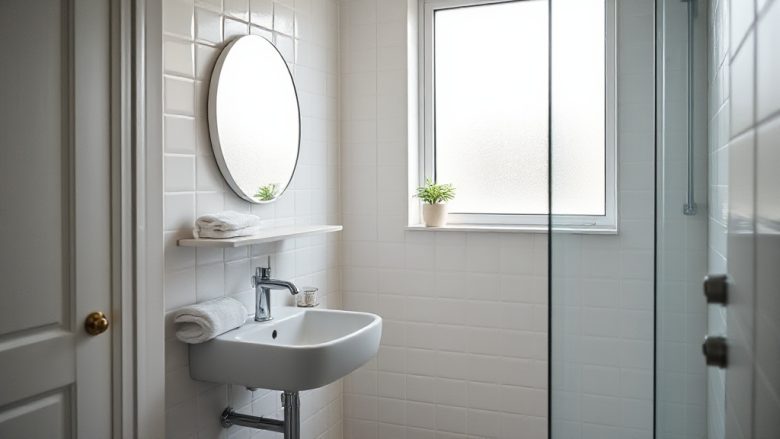
Moderate cost. Replace a chunky vanity with a wall-hung basin and a slim shelf, or a vanity on legs. Seeing floor underneath a unit makes the room read as larger. This is the single most effective change in most small bathrooms I’ve worked on.
Higher cost. Move the door to open outward, or swap it for a sliding or bi-fold door. A door that swings into a small bathroom removes a usable square metre. If the layout allows it, this is worth doing properly rather than patching.
Biggest cost. Reconfigure the layout so the toilet, basin and shower aren’t all competing for the same strip of floor. This usually means moving the soil pipe, which is why it sits at the bottom of the list. Do it only if you’re already retiling.
It Feels Dark: Lighting and Surface Fixes for a Dim Bathroom
Dark bathrooms are almost never dark because of the wall colour. They’re dark because the light source is in the wrong place, or because something is blocking the light that already exists.
Free. Clean the window, the extractor grille and any light fittings. Sounds silly, but a film of soap scum and dust on a diffuser can cut a surprising amount of light, and it takes ten minutes.
Low cost. Change the bulbs. Match the colour temperature across the room. A cold white bulb over the mirror and a warm one overhead makes a bathroom look shabby even when it’s clean. Pick one temperature, ideally around 3000K to 4000K, and use it everywhere.
Low to moderate cost. Add light at the mirror rather than above it. Light coming from directly overhead casts shadows under your brow and makes the whole room feel dimmer than it is. Two small wall lights either side of the mirror, or a backlit mirror, fixes this immediately.
Moderate cost. Add a second circuit so you can have bright task lighting and softer ambient lighting separately. Being able to dim or switch off the overhead light changes how the room feels in the evening.
Higher cost. Replace the window or add a light well if the room genuinely has no external light. If that isn’t possible, don’t fight it. Lean into a deliberately warm, enclosed feel with better artificial light rather than trying to fake daylight.
One surface note: gloss finishes bounce light around, matt finishes absorb it. If the room is dark, keep large surfaces lighter and use gloss or satin on at least one plane, usually the wall opposite the window.
It Never Dries Out: Solving Damp, Mould and Poor Ventilation
This is the problem people underrate, and it’s the one that costs the most if ignored. A bathroom that never dries out will rot sealant, blister paint, stain grout and eventually damage the structure. Fix ventilation before you fix anything cosmetic, because new paint over a damp wall is money thrown away.
Free. Open the window during and after every shower, and leave the door open once the room is empty so air can move through. If the window is sealed shut with paint, free it. This is the cheapest fix and the most commonly skipped.
Low cost. Stop trapping moisture. Squeegee the shower screen and walls after use, hang towels on a rail rather than over the bath edge, and don’t leave wet mats on the floor. Wipe down the worst surfaces. Ten seconds of squeegeeing prevents most of the mould that appears in corners.
Low to moderate cost. Check the extractor fan actually works. Hold a piece of tissue against the grille while it runs. If the tissue doesn’t stay put, the fan is either dead, blocked, or ducted badly. Clean or replace it, and make sure it’s sized for the room. A fan that runs on for ten minutes after the light goes off is worth the small extra cost.
Moderate cost. Re-seal the shower and bath edges with a proper mould-resistant sanitary sealant, removing the old sealant completely first. Sealant applied over old sealant fails within months.
Higher cost. Fix the underlying cause. If the fan ducts into the loft or a dead space instead of outside, it’s just moving moisture around. Correcting the ducting, or adding a humidity-sensing fan, solves the problem properly. If you have a cold external wall, consider whether insulation or a different wall finish is needed.
It Looks Dated: Updating an Old-Fashioned Bathroom Without a Full Renovation
Dated bathrooms usually date themselves through a handful of specific features rather than the whole room. Find those features and you can modernise the room for a fraction of a renovation.
Free. Remove everything that isn’t fixed. Old soap dishes, suction shelves, novelty accessories, mismatched towel hooks. An empty room always looks more current than a cluttered one.
Low cost. Replace the small stuff in one consistent finish. Taps, towel rail, toilet roll holder, hooks and cabinet handles in a single metal finish will do more for the room than new tiles. Mixing chrome, brass and black is what makes a bathroom look accidental.
Low to moderate cost. Re-grout and re-seal. Fresh white grout between existing tiles makes old tiles look intentional again. If the tiles themselves are a dated colour, consider tile paint as a temporary measure, though it wears in wet areas and needs honest expectations.
Moderate cost. Replace the mirror, the vanity and the light fitting together. These three items carry most of the visual weight in a bathroom. Changing them as a set makes the room feel designed rather than patched.
Higher cost. Retile the walls, or replace the suite. Do this only when the layout and ventilation are already sorted, otherwise you’ll be retiling again sooner than you’d like.
What to Skip, and the Order to Do It In
Some popular fixes aren’t worth the money. Heated towel rails are lovely but useless in a room that never dries out. Statement wallpaper in a bathroom without proper extraction will peel. Deep-pile mats hold moisture and make a damp room worse. Very dark tiles in a small, dark room will make it feel like a cave, however good they look in a showroom. And don’t buy storage before you’ve cleared what you already have, or you’ll just organise the clutter.
If you’re doing more than one thing, work in this order. Sort ventilation first, because everything else depends on the room being dry. Then lighting, because it changes how every surface reads. Then clear and declutter, which costs nothing. Then replace the small hardware in a consistent finish. Then tackle the larger items like the vanity, mirror and screen. Leave retiling and layout changes until last, when you know the room works.
Done in that order, most bathrooms improve noticeably for a modest spend, and the expensive work happens once, on a room that’s already dry, bright and functional.
Frequently Asked Questions
How can I improve my bathroom interiors on a small budget?
Start with ventilation and lighting, then declutter. Cleaning the extractor, freeing a painted-shut window, matching your bulb colour temperature and adding light at the mirror cost very little and change the room more than new tiles would. After that, replace taps, hooks and handles in one matching finish.
What is the most important fix in a damp bathroom?
Ventilation. If the extractor fan doesn’t clear the room, or ducts into a loft rather than outside, no amount of re-sealing or repainting will hold. Fix the airflow first, then repair the cosmetic damage it caused.
Can I modernise an old bathroom without replacing the suite?
Yes, in most cases. Replacing the mirror, vanity, light fitting and hardware as a matched set, plus fresh grout and sealant, updates the look considerably. Keep the existing suite if it’s sound and the layout works.
Should I use dark tiles in a small bathroom?
Only if the room has strong natural light and good artificial lighting. In a small, dim bathroom, dark tiles absorb what little light there is and make the space feel tighter. Lighter large-format tiles with a gloss or satin finish usually work better.