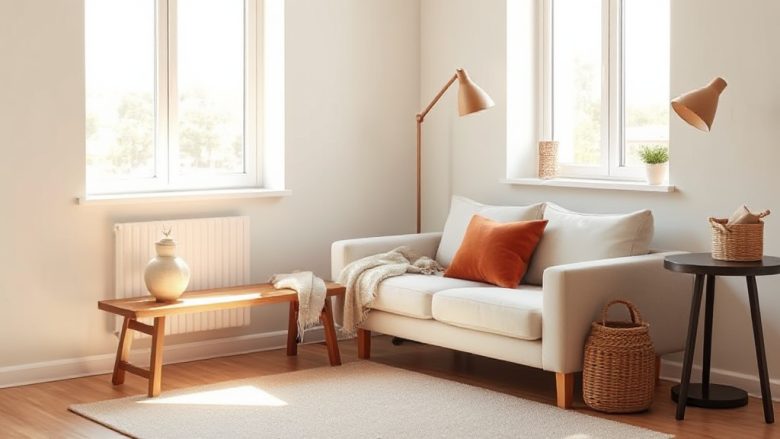
You’ve seen the photos. A pale sofa, a single ceramic vase, light pooling across an empty floor. It looks calm in the magazine. In your own flat, the same approach produces a room that feels less like a sanctuary and more like a waiting area. The walls are bare, the corners are echoing, and you can’t shake the feeling that you’ve simply moved all your personality into a storage unit.
This is the gap between minimalist decor as a photograph and minimalist decor as a way of living. Most of the expert advice on minimalist decor you’ll find online assumes you own your space, have a renovation budget, and don’t need to hide a bicycle behind the sofa. Renters face a different set of constraints, and the standard rules often make things worse.
Before you donate another bag of belongings or repaint a wall you’ll have to repaint again at move-out, it’s worth examining the three myths that send most people off course. Each one sounds sensible. Each one quietly works against the feeling you’re trying to create.
Myth one: Minimalism means owning less
The most persistent myth is that minimalism is a numbers game. Fewer books, fewer mugs, fewer chairs. If you can count your possessions, the thinking goes, you’ve succeeded. This is why so many decluttering attempts end with a room that looks tidy but feels hollow — the objects are gone, but nothing has replaced the function they served.
Objects do work in a room. A stack of paperbacks absorbs sound and softens a corner. A heavy ceramic bowl on a shelf catches light and gives the eye somewhere to rest. When you remove those things without replacing their job, you don’t get calm. You get a room that behaves like an empty hallway.
Renters are especially vulnerable to this trap because you often can’t change the fixed elements — the beige carpet, the landlord’s light fitting, the awkward radiator placement. Removing your own things leaves only the parts of the room you never chose. That’s why a stripped-back rental can feel more like a waiting room than a home. The problem isn’t the amount you own. It’s whether each remaining object is doing something useful.
What to do instead
Stop counting and start assigning jobs. Go through one room and ask of each visible object: what is this doing here? A lamp provides light at a useful height. A rug defines a seating area and deadens footsteps for the neighbours below. A framed print gives the eye a focal point on a wall you can’t paint.
If something has no job, it’s a candidate for removal. If it has a job, it stays, even if it’s the fifth cushion or the third plant. The goal isn’t an empty shelf; it’s a shelf where everything on it earns its place. That distinction sounds small, but it changes what you keep and what you let go.
For renters, this also means being honest about storage. If you genuinely need the space under the bed for suitcases, that’s not clutter — that’s infrastructure. Minimalist decor doesn’t require you to pretend you don’t own a winter coat.
Myth two: Minimalism has to be white, grey and beige
Somewhere along the way, minimalism got confused with a specific colour palette. Scroll through enough interiors content and you’d think the only acceptable options are off-white, warm grey, and a shade of beige that has been gently toasted. Anything with saturation is treated as a failure of restraint.
This is a myth, and it’s an expensive one for renters. If your flat already has magnolia walls and a grey carpet, adding more neutral furniture doesn’t create a serene backdrop. It creates a room with no contrast, no depth, and nothing for the eye to hold onto. The result reads as unfinished rather than intentional.
Colour isn’t the enemy of minimalism. Unconsidered colour is. A single deep green cushion on a pale sofa does more for a room than five variations of oatmeal. A dark wood side table against a light wall gives the space a centre of gravity. Minimalism is about editing, not about bleaching.
There’s also a practical argument here for anyone renting. Landlords tend to choose neutral finishes because they’re inoffensive and easy to repaint. If you match your own belongings to that neutrality, you’re amplifying the least interesting qualities of the space. You’re not decorating; you’re blending in.
What to do instead
Pick one or two colours you actually like and use them deliberately. Not everywhere — just enough to give the room a pulse. A rust-coloured throw, a navy lampshade, a print with a bold block of colour. The rest of the palette can stay quiet so those choices read as decisions rather than accidents.
Texture matters as much as colour, especially in a rental where you can’t change the walls. A chunky knit blanket, a linen curtain, a woven basket, a rough plaster vase — these give a neutral room something to feel. Without texture, a beige room is just beige. With it, the same room becomes layered and calm.
And don’t overlook lighting. A single overhead bulb flattens everything it touches. Two or three smaller light sources at different heights — a floor lamp, a table lamp, a warm bulb in a corner — will do more for a minimalist room than any amount of repainting. It’s the cheapest transformation available to a renter, and it’s almost always skipped.
Myth three: Minimalism means everything must be hidden
The third myth is about concealment. Cables tucked away, clutter banished, surfaces wiped clean. If it isn’t essential, it shouldn’t be visible. This sounds disciplined. In practice, it produces rooms that feel like show homes — technically tidy, emotionally cold, and slightly unwelcoming.
There’s a difference between clutter and evidence of life. A bowl of fruit, a book left open, a pair of shoes by the door — these aren’t failures of minimalism. They’re signals that a person lives here. Strip them all away and you get a space that photographs well and feels wrong to sit in.
The hiding instinct also creates a practical problem for renters. If everything must be concealed, you need storage, and storage in a rental is often scarce. You end up buying more boxes, more baskets, more furniture with lids — which is more stuff, not less. The pursuit of visible emptiness generates invisible accumulation.
What to do instead
Decide what deserves to be seen. A few objects you genuinely love, displayed with space around them, will do more for a room than a perfectly empty surface. The space around them is what makes them read as intentional rather than accidental.
Group things rather than scattering them. Three books stacked with a small object on top reads as a considered arrangement. The same three books spread across a shelf read as mess. The objects haven’t changed; the composition has.
Leave one surface genuinely clear — a bedside table, a windowsill, a section of kitchen worktop. That single empty plane gives the eye somewhere to rest and makes the rest of the room feel calmer by contrast. You don’t need every surface bare. One is enough.
And be realistic about what you actually use daily. If you make coffee every morning, the kettle and grinder belong on the counter, not in a cupboard. Function beats aesthetics when the two conflict, and a room that works is a room that feels good to be in.
A short checklist before you change anything
Walk into the room that bothers you most and stand still for a minute. Ask what the room is for, not what it should look like. Then check three things: whether each visible object has a job, whether the palette has at least one deliberate point of contrast, and whether there’s a single clear surface for the eye to rest on.
If any answer is no, you’ve found your starting point. You don’t need to buy anything. You don’t need to throw anything away. You need to rearrange what’s already there, remove what isn’t working, and stop apologising for owning things. Minimalist decor isn’t about having less. It’s about being clear about what you have.